If you've been reading about AI, you've seen three terms used almost interchangeably: AI, machine learning, and deep learning. Tech articles toss them around as if they mean the same thing — which leaves a lot of people nodding along without really understanding.
They don't mean the same thing. They're nested — like Russian dolls. AI is the biggest idea, machine learning sits inside it, and deep learning sits inside machine learning. Understanding that nesting makes all the AI news you read click into place. Let me show you, in plain terms, what each one is and how they fit together.
What we'll cover
The Russian doll: how they nest Machine learning: learning from examples Deep learning: learning in layers The differences, clearly Real-world examples of eachThe Russian doll: how they nest
Here's the simple mental model that clears up all the confusion:
- Artificial Intelligence (AI) — the whole field: building machines that can do things that normally require human intelligence. The biggest, broadest category.
- Machine Learning (ML) — the most important approach to AI: teaching machines to learn from data instead of following hand-written rules. It's the technique that made modern AI possible.
- Deep Learning (DL) — a special, powerful type of machine learning that uses networks with many layers, inspired loosely by the brain. It powers the most impressive recent AI.
So: every deep learning system is machine learning, and every machine learning system is AI. But not every AI is machine learning, and not every machine learning is deep learning. Got it? Let's go deeper on each.
Machine learning: learning from examples
Before machine learning, programmers tried to make AI by writing explicit rules — "if the photo has pointy ears, it's a cat; if it has a long snout, it's a dog." This approach, sometimes called "classic AI" or rule-based AI, works for narrow, well-understood problems but fails badly at anything nuanced.
Machine learning flips that idea. Instead of writing rules, you show the computer thousands of examples and let it figure out the rules itself.
Recall the picture from our beginner guide: show a system millions of labeled photos ("cat, cat, dog"), let it guess, correct it when wrong, and repeat until it learns to recognize animals on its own. That's machine learning.
The key phrase is "learning from data." The machine isn't told the answer by a programmer — it discovers patterns from examples. This is what made modern AI explode: instead of programming every edge case, you just feed it data and it learns.
Deep learning: learning in layers
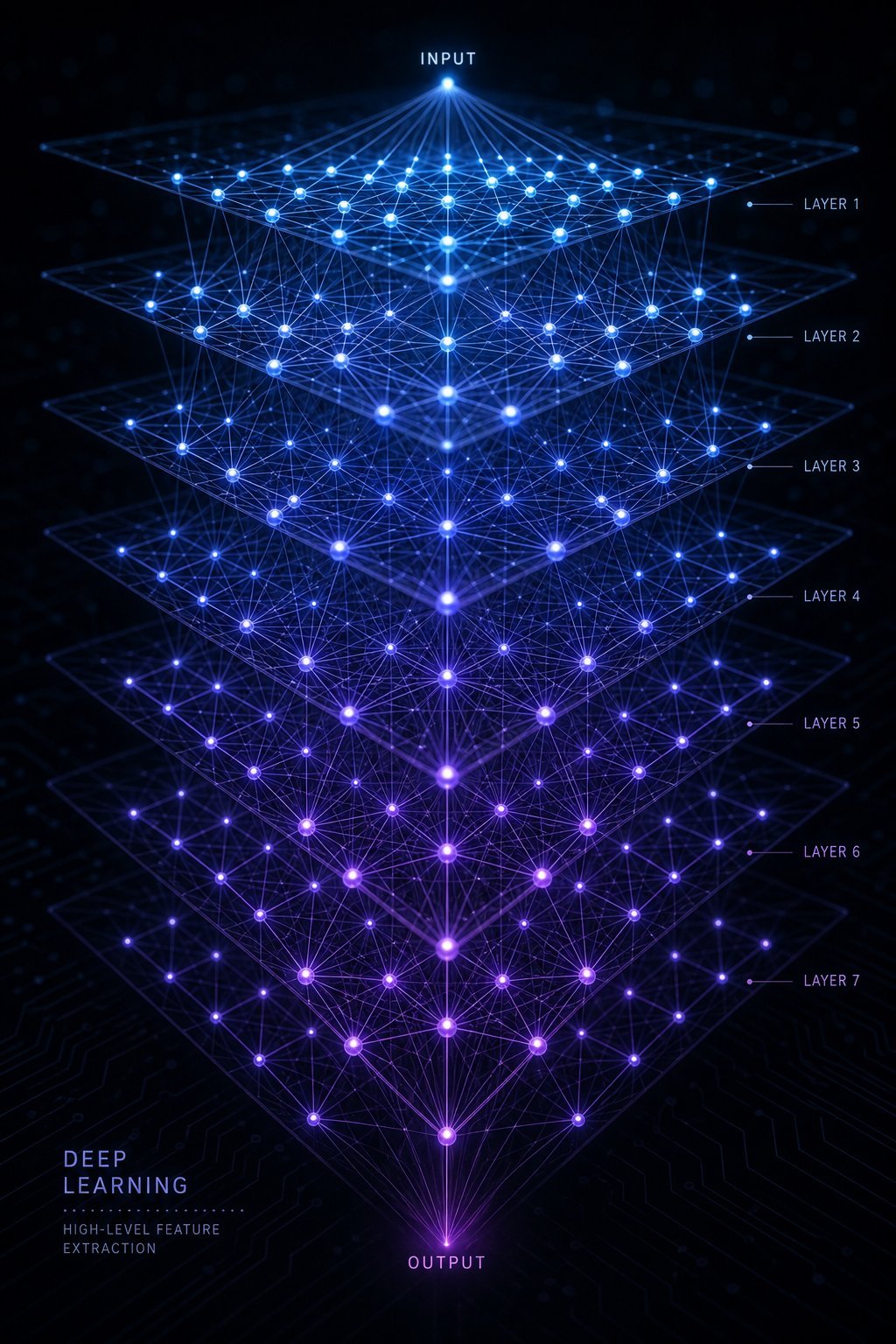
Deep learning is a specific, very successful kind of machine learning. Its distinguishing feature is the use of artificial neural networks with many layers — hence "deep" (many layers, not "deep" in the philosophical sense).
A neural network is a way of computing that's loosely inspired by how biological brains connect neurons. Data flows through a network of interconnected "nodes," each one doing a tiny bit of processing and passing results to the next layer. With many layers stacked up, the network can learn incredibly complex patterns.
Here's the important idea: deep learning can find patterns that traditional machine learning misses. In earlier machine learning, humans often had to "hand-engineer" features — decide what mattered (edges, colors, textures). Deep learning removes that step: given enough data, the network discovers its own features and patterns, layer by layer, with remarkable power.
✨ Why "deep" matters
The "deep" in deep learning refers to the many layers in the network, not to some deep understanding of the world. Each layer learns a slightly more complex pattern — from simple edges in the first layers, up to full faces and objects in the deepest layers.
The differences, clearly
Let's put them side by side so the differences are unmistakable:
| Classic AI | Machine Learning | Deep Learning | |
|---|---|---|---|
| How it learns | Hand-written rules | Learns from labeled data | Learns from data, many layers |
| Data needed | Little | Moderate | Very large amounts |
| Human input | High (write rules) | Medium (choose features) | Low (finds features itself) |
| Computing power | Low | Moderate | Very high (GPUs) |
| Complexity it handles | Low | Medium | Very high |
The trend is clear: as you move from classic AI to deep learning, the machine needs more data and more computing power, but it can handle far more complex tasks with less human hand-holding.
Real-world examples of each
To make it concrete, here's where each technique actually shows up today:
- Classic AI (rules): chess programs, simple if-then automation, early navigation systems. These follow explicit, programmed logic.
- Machine learning: spam filters, credit card fraud detection, recommendation engines, house-price prediction, medical diagnosis from charts. These learn patterns from historical data.
- Deep learning: image recognition, speech recognition, translation, self-driving cars, chatbots like ChatGPT, and AI image generation. These handle the hardest, most human-like tasks.
If a system recognizes a face, understands your voice, or generates realistic images, it's almost certainly using deep learning. If it predicts or classifies based on data in a simpler way, it's likely machine learning. And if it just follows fixed rules, it's classic AI.
📌 Bottom line
AI is the whole field of building intelligent machines. Machine learning is the approach of teaching machines from data rather than rules — it's what makes modern AI work. Deep learning is a powerful, layered type of machine learning that excels at complex tasks like recognizing faces and understanding language. Remember the nesting: deep learning ⊂ machine learning ⊂ AI. With that simple picture, the tech headlines start making much more sense.